
Comparison
PCA vs Tensor SPC
Vectorized PCA is an important baseline, but it treats structured observations as flat vectors. Tensor SPC preserves the modes that can carry process meaning.
Why compare them?
PCA/MSPC is widely understood and useful. Tensor SPC should not be presented as a universal replacement. The question is where preserving multiway structure improves detection, localization, or interpretation.
The comparison matters most when faults are mode-specific, time-localized, or tied to interactions among variables and conditions.
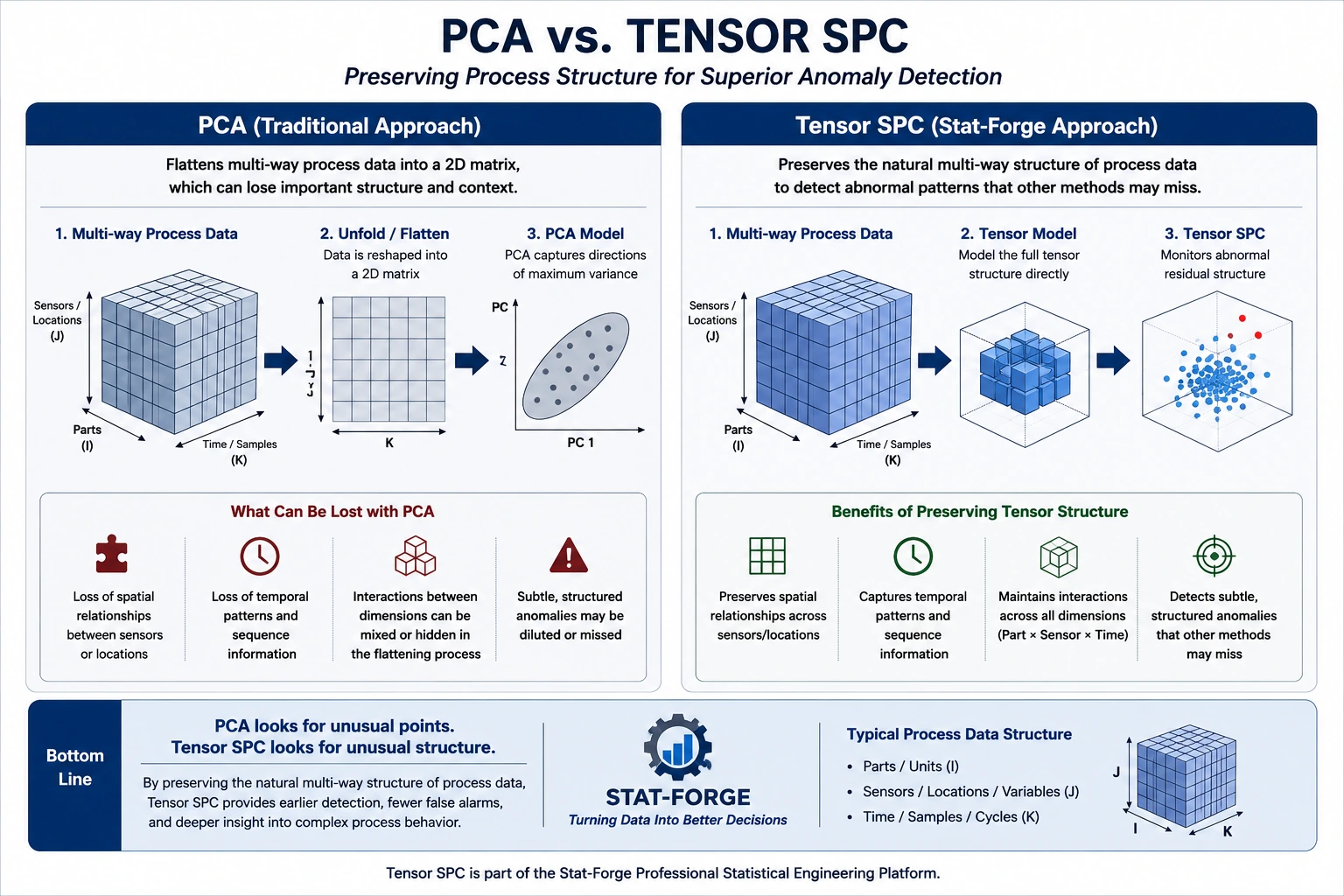
PCA flattens the observation; Tensor SPC preserves the organized modes.
| Question | Vectorized PCA/MSPC | Tensor SPC |
|---|---|---|
| How is data represented? | Flattened into a single vector | Retained as sensor × time × condition or similar tensor |
| What structure is modeled? | Global covariance after flattening | Mode-wise multilinear structure |
| Primary statistics | PCA T² and SPE/Q | Tensor T² and tensor Q |
| Interpretability | Can be harder after flattening | Residuals can be mapped back to modes |
| Best use | Strong baseline for multivariate monitoring | Structured signatures, localized faults, multi-mode process data |
Where PCA may be enough
- Data are naturally vector-valued.
- The number of variables is moderate.
- Interpretability by mode is not critical.
- Faults are broad and global.
Where Tensor SPC may help
- Observations are naturally matrices or tensors.
- Faults are localized by time, sensor, feature, or condition.
- You need residual heatmaps or mode-aware interpretation.
- Flattening hides meaningful relationships.